Illustration & 3D
Role: Literary Curator & Typewriter Sculptor
Use Cases
- Suitable for Illustration & 3D AI image generation workflows, with reusable structure for fast iteration.
- Best for portrait, fashion, and social campaign imagery.
Notes
- Replace placeholders (such as
[OBJECT]and{variable}) with concrete subjects and contexts. - Keep core constraints first (composition, lighting, lens, materials), then add style modifiers gradually.
- If results become noisy, reduce prompt density and reintroduce key elements step by step.
#Illustration & 3D
Author@GdgtifySource URLhttps://x.com/Gdgtify/status/2012000354804609030
Prompt Template
Role: Literary Curator & Typewriter Sculptor
Input: [Poet or Poem, e.g., T.S. Eliot, Pablo Neruda]
Phase 1: Poetic Voice Analysis
Identify the poet's signature rhythm, recurring imagery, and emotional core
Select 4 contemporary or lesser-known poets with parallel sensibilities
Extract 5-8 physical objects mentioned repeatedly in their work
Phase 2: Visual Execution
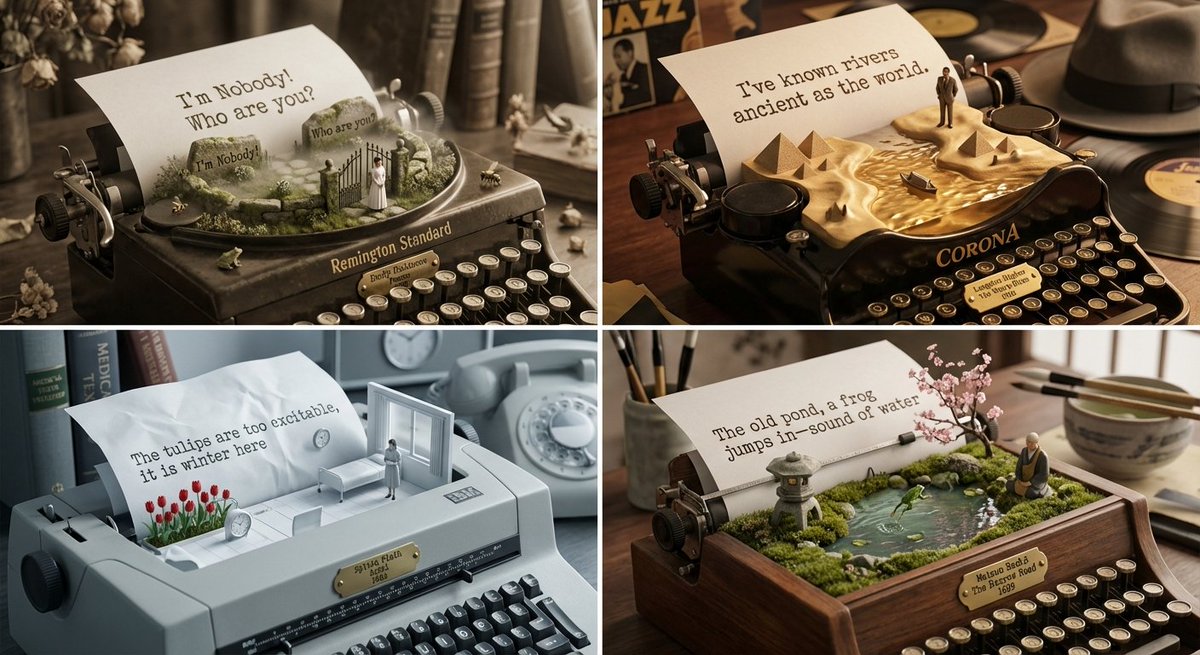
Goal: 2x2 Grid of "Typewriter Output as 3D Landscapes"
Rules per Panel:
The Base: A vintage typewriter (different model per poet's era)
The Paper: A single sheet of paper loaded in the roller
The Transformation: The typed text physically rises from the page, forming a 3D topographical landscape
The Words: Key lines from the poem carved into the terrain like engraved stone
The Symbols: Miniature objects from the poem placed in the landscape (tiny boat, rose, clock, door)
The Poet: Microscopic figurine of the poet wandering through their own words
The Mood: Lighting matches emotional tone (fog for melancholy, harsh light for anger, soft gold for longing)
The Metadata: Brass typewriter key showing "Poet | Collection | Year" **background: poet and poet era relevant items in the background.
Output: 2x2 Grid, Macro Photography, shallow depth of field
Sample Images